Chapter 16
Adams County Record Story
Scoria Lily Ranch House Complete
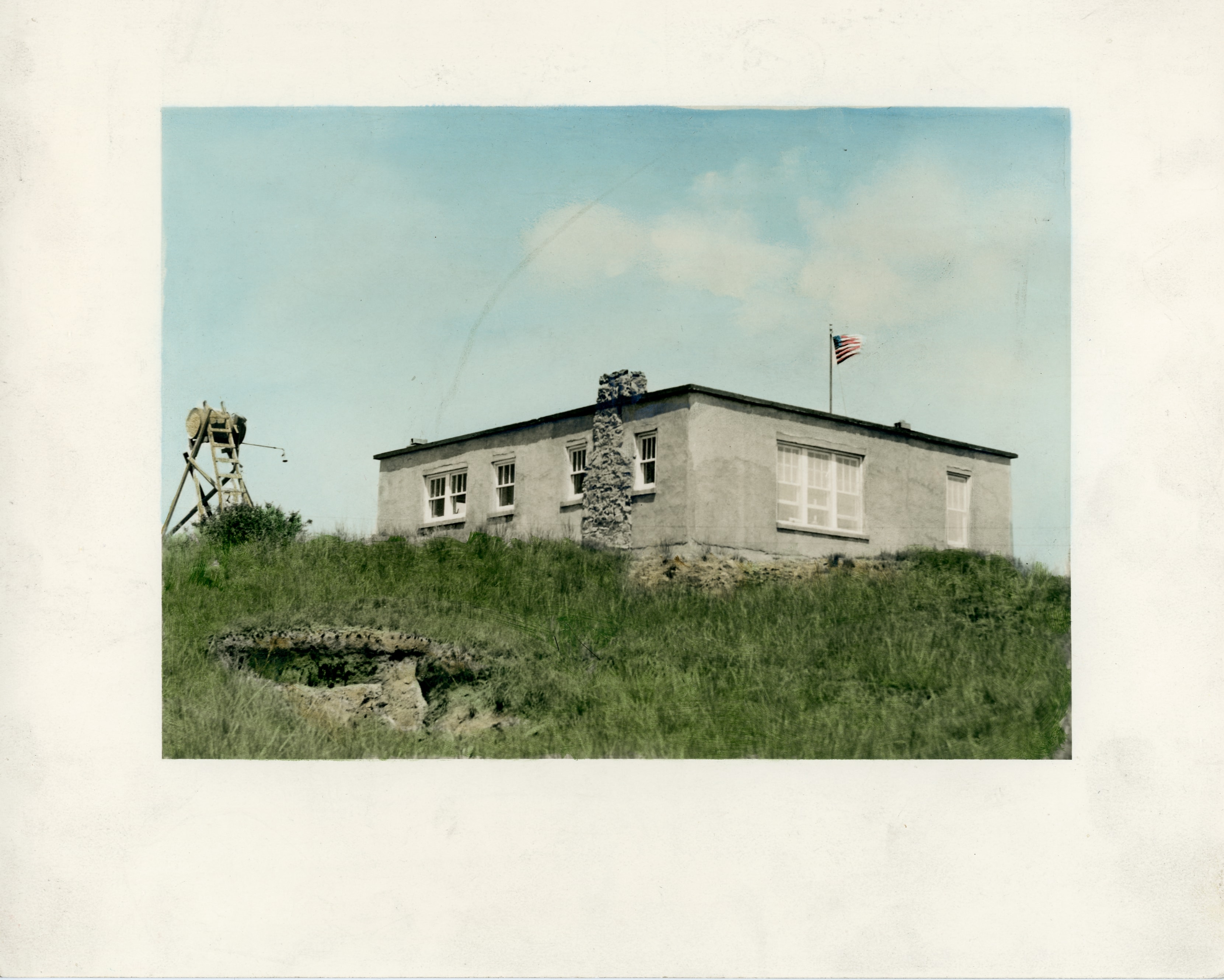
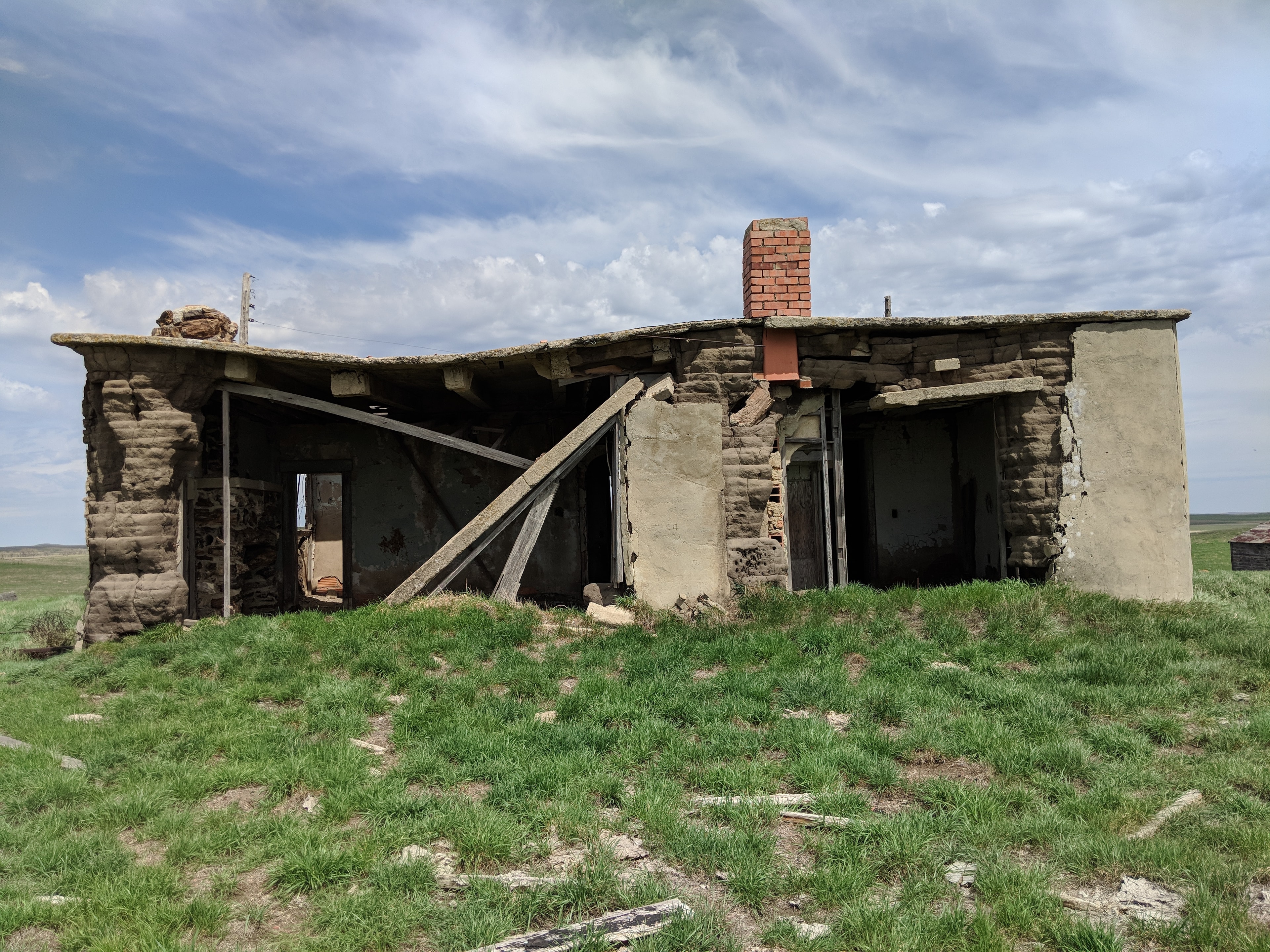
"One of the most significant buildings ever erected in North Dakota will be thrown open to the inspection of hundreds of persons this week when Col. Paul Southworth Bliss and his mother, Mrs. Olive I. Bliss, open the doors of their new all-fireproof, rammed earth house at Scoria Lily ranch, 12 miles east of Hettinger.
"The program is in two parts, the first consisting of motion pictures of the building in various stages of construction and depicting the various processes. These pictures will be shown by Col. Bliss in the court room of the Adams County court house, through the courtesy of county officials and employees, Saturday afternoon, Jan. 2.
"The housewarming itself will take place the next day on Sunday, Jan. 3."
"Scoria Lily ranch had its beginning in 1910 when Mrs. Olive Irene Bliss, Col. Bliss' mother, bought the quarter section of land on which the buildings are now located. Little was done with the property except for hay, although a small part was broken and cultivated from time to time.
"Mrs. Bliss will come from St. Paul, where she now lives, to attend the housewarming events, and will arrive in Hettinger New Year's Eve. She visited the ranch during the summer with Mrs. Miriam McIntyre of Rochester, N.Y., her only daughter, Col. Bliss' sister.
"Believing that North Dakota is shortly to emerge from its major drouth, Col. Bliss began improving the property last year, and determined on the use of rammed earth. His attention had been called to its use by C.A. Huber, formerly of Carson, then in the employ of the FERA engineering department at Bismarck.
"Huber, a young civil engineer, who worked his way through the engineering school at the University of North Dakota and is now construction engineer at Fort Totten Indian Reservation, came to Hettinger one Saturday afternoon in August, 1935, and the two laid out the markings for a garage. Farm neighbors under the foremanship of James E. McIntyre were assembled and the work began. For all it was experimental.
"'I'll never forget the shout that went up when we took the plank forms off the first section of the rammed earth wall,' said Col. Bliss, 'and we found that it stood and didn't fall down as I am sure some of the lads expected.' From that time on work went rapidly. Having seen how good rammed earth was for a garage, he determined to try a house. Mr. Huber prepared a design. He wanted it fireproof with a central hall to provide for two families, or for owner and tenant, and sketches were made with that in mind."
"'I do not want to give the impression that this (house) is intricate or difficult. That it isn't is proved by the fact that neither Mr. Huber or I knew anything about it except that which we had read in books, and the farmers who have worked on the garage and house knew as little as we. But we had the spirit of pioneering, and experience came with doing,' said Col. Bliss.
"'I know that any farmer can, with his sons, create good housing for himself and family, for his animals and for his machines, out of rammed earth. It is permanent housing, designed to meet a temperature range of 175 degrees, designed to stand on a hill in the wind without a tremor or a sound—beautiful, efficient and economical housing.'
"Col. Bliss was formerly a newspaper man. He served in the war as a captain, later major of infantry in France. Later he went into Community Chest work in Minneapolis and St. Louis and then came to North Dakota to make his home. He has been connected with the governmental organizations, the FERA and WPA since 1933. He is an enthusiastic booster for home-crafts and will have nothing except home made materials in his home. He is also the author of several volumes of poetry."
Rammed Earth House Letters from 1936
Letter to Secretary of Agriculture Henry A. Wallace
On New Frontiers and rammed earth construction
Dear Mr. Wallace:
I want to tell you how much I liked your "New Frontiers." It is a marvelous piece of reasoning and is philosophical in that it looks at the city and the farmer not as two different creatures but as one. A friend loaned me his book and it has been going the rounds of the WPA office here and I can't get it back at present to tell you definitely what thoughts and pages I liked best.
I was formerly a city man pretty largely, but I am doing some farming now and of course have come to sympathize more keenly with the agricultural point of view. But having a city slant, I hope I can look at the thing from both angles without prejudice.
I have built a rammed earth garage in Adams County in the southwestern part of the state, and I am sending you a clipping from the Minneapolis Journal of March 6th about it. I have had a great many inquiries about this and have sent them a mimeographed bulletin. A good many of them tell me that the governmental bulletin entitled Rammed Earth Building is out of print. I wonder if it can't be restored. Somebody down there wrote me asking if the bulletin on adobe wouldn't do as well. Personally, I detest adobe. It involves a good many more processes and movements than rammed earth. North Dakota farmers don't do any fall plowing and anything we can do to invest their time in building better homes, barns, and shelters for machines, will be all to the good.
The Dakota Farmer of January 4, published by W.C. Allen of Aberdeen, South Dakota, had a page devoted to my rammed earth garage dedication and I have had a tremendous amount of favorable reaction from that all over the Dakotas.
Wishing you success in your work, I am,
Very sincerely yours,
Paul S. Bliss, Asst. State Dir.
Div. of Employment, in charge of Intake and Certification
* * *
Letter to W.C. Allen
On the Farm-Hall design and rammed earth club house
Dear Mr. Allen:
I am delighted to know that you are interested in a club house because that means something fine for the people who will use it and thus get closer to nature. And I am also glad that you are considering rammed earth. I have two pieces of advice. One is to take Mr. Parmley, and go and thoroughly inspect the rammed earth experiments being so successfully carried on by Prof. Ralph L. Patty, at South Dakota State College. I have not seen these myself but have very much wanted to go down there.
The second is to obtain a construction engineer with abounding faith in rammed earth—the way I did. The young chap who drew the plans and engineered my building at Scoria Lily ranch was Christian A. Huber, a recent graduate of the University of North Dakota engineering department. He is now connected with the Resettlement Administration, but I know he would be glad to be of any help to you he could, and probably would go down there for a couple of days to get them started. He has a whole soul interest in this sort of thing.
Incidentally he just gave me some sketches for a "Farm-Hall." This is a name I am choosing for farm houses built of rammed earth. I know you will be interested in this and I will be glad of your reactions. You will note that the building makes use of the roof. When it is hot in summer you can go up there and sit on the breeze. Particularly at night it would be very lovely. I personally am very much interested in the stars and will go up there every night to look at them.
I may even have a smooth floor so that the folks may dance up there believing as I do that recreation is very important. When the building is dedicated I will have an ensemble playing beautiful music from the top and the guests can come up on the roof and dance if they want to.
Another innovation is what I call the abolition of the usual under-the-house cellar, which takes away from a farm house the idea of living. After all, why have a cellar when you can have so much outside room? You will note that my fuel cellar and vegetable cellar are outside the building.
These are merely tentative plans. They call for 18 inch earth walls for the first story and 12 inch rammed earth walls for the second.
Wishing you and Mr. Parmley the greatest success in your leadership of the committee, I am,
Very sincerely yours,
Paul S. Bliss, Administrative Assistant
* * *
Letter to Mr. Hallen
On patience, drought, and building for the future
Dear Mr. Hallen:
I am so sold on this type of construction that I wish many of the farmers down there would undertake something of the same sort.
Of course they are so knocked out by what has happened to them this year that they are about paralyzed but if they could get busy and turn this year into a couple of buildings they would be getting ready for the prosperity that is coming. All we have to do is be patient. In a few years people who are talking about moving everybody out will be awfully surprised. There is no room elsewhere in the country for the people so we might as well stay here and lean on the government if necessary.
It all goes to show how short we really are of suitable homestead lands fit for agriculture. For a big section of every fifty years you can farm in western North and South Dakota. The rest of the time it is pretty tough going. The government might as well admit it and then let's be patient and not worry. But it's pretty hard not to get the jitters when you see grasshoppers in great swarms, terrible drouth, and burning heat.
How busy are you going to be this summer? With many of the boys idle I might want to start doing a little work of a building nature if I can arrange it.